Showing posts with label special education. Show all posts

Wednesday, April 9, 2014

DIY Sped Adaptations in the Art Room.

After looking at the variety of backgrounds my students created during our recent Magritte Moon Trees, I was struck not only by the gorgeous colors, but by the following two paintings.  The first painting is a lovely example of a student who followed the directions to use cool colors to create their sky and landscape background to a "T".


Now, the second painting is an example from one of my students on the spectrum.  This young artist is absolutely amazing.  He'll appear like he's zoning out for my entire demonstration and/or discussion and then raise his hand and say the most beautiful and insightful thing.  The work that this child produces definitely has a unique style.  Though this is only the background for his project, this paper itself is frameworthy for sure!


After looking at these paintings, I started to think about some of the tools I use in my Art Room for my students with special needs.  I've blogged a little bit about the supports I use in my room here, and I thought I'd continue my previous train of thought just a lil' bit.  As a former Special Education teacher, I am always on the hunt for different ways to adapt everyday art tools, so below is a glimpse into these adaptations.


I like to use the chunky Ticonderoga pencils in my room.  They are super smooth for writing and drawing and the lead is very sturdy so they barely break.  For some of my kiddos with fine motor difficulties, a rubber band wrapped near the top encourages children to hold onto it with their thumb and index finger.  The rubber band leaves a nice little tail for children to grasp with their additional fingers.


I always have one of these fidget balls on hand for any students with sensory needs too.  Students with anxiety may use this to secretly hold and squish in their hands while I'm giving a demonstration or leading a discussion.  I have a few friends too who hold onto this with their non-dominant hand while painting, drawing, etc. because it keeps both hands occupied.


These google eye rings are the BEST.  I used these as a Kindergarten teacher, a Sped. teacher, and now in my Art Room.  These goofy rings actually help students self-check and self-assess their pencil/crayon/brush grip.  If the student is holding their tool accurately, then the art eyes are always watching.  If the grasp is incorrect, then that signals to the child to readjust his or her grip.


I've also got a few pads of felt scraps always on hand.  The felt is a nice sensory texture tool to use with students on the spectrum.  It gives their hands something safe and sensory to touch and is used similarly like the fidget ball above.  Depending on the child, the felt pad can be placed on the table or in the child's lap.


For some students with difficulties in writing, a slant board works well to encourage appropriate letter formation and posture, or in the case of art, appropriate artistic techniques.  Because I don't have slant boards available in my room, a 3"(or more) binder works really well too!

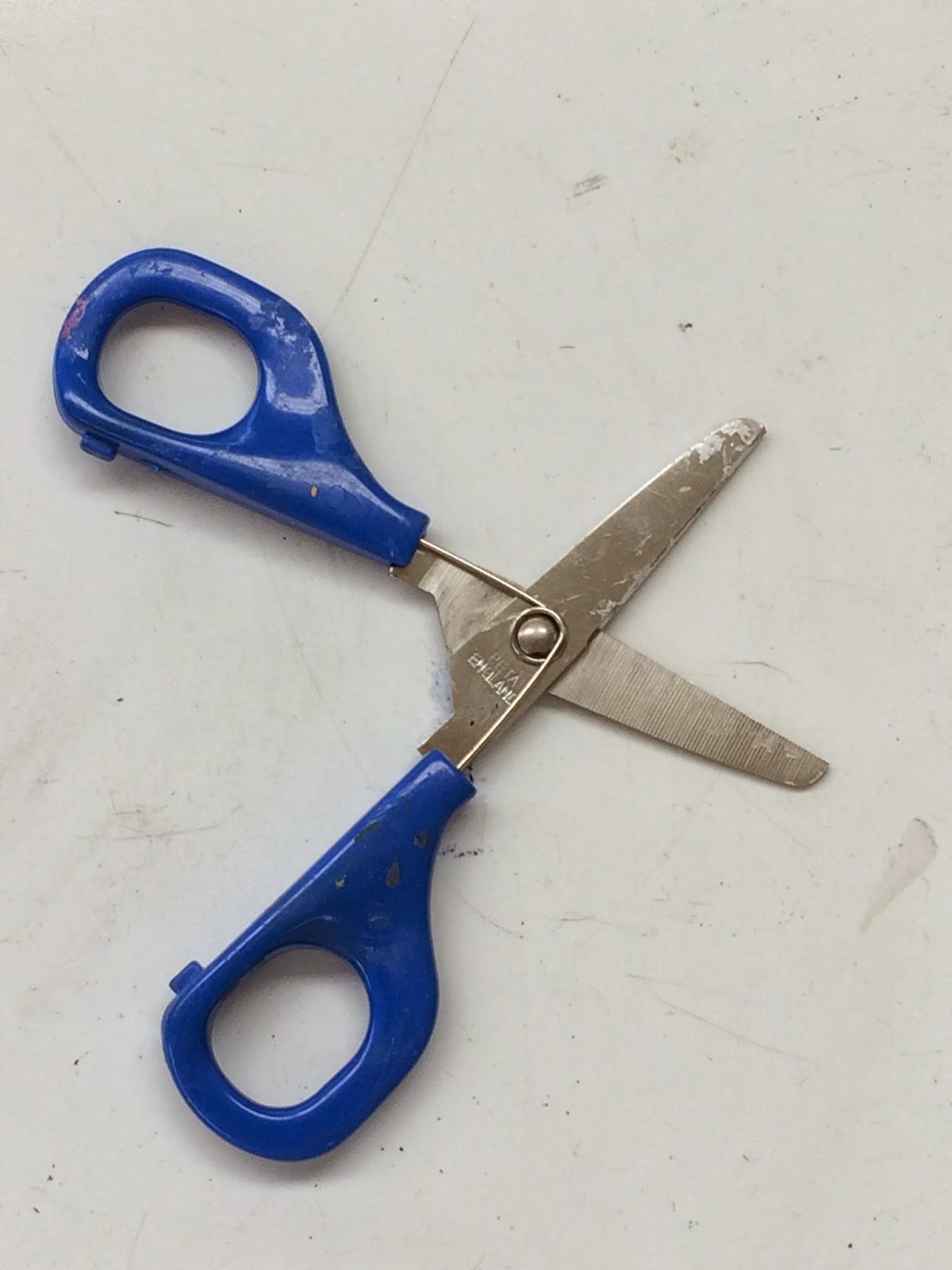
And finally, these last tools below work really well for students with difficulties in motor skills.  The bouncy self-opening scissors are a great tool for students with weak hands.


Annnnnd, the sponges below are also a great alternative to brushes if students have difficulty grasping a paintbrush.  The wood handle sponge and the clothespin sponge allow students to experience painting, paint in details,  and they are more conducive to certain students' grasps.


My fabulous art friend also suggested using these Aqua Flow Brushes for students who may have difficulty maneuvering a traditional brush for watercolors or tempera cakes.  To use them, you need to pre-fill them with a little water and students can gently squeeze in combination with paints for more control than a regular brush.


A few other tidbits I'd like to share:

- I always have a few extra gloves (non-latex) in the Art Room for students who may experience sensory anxiety when handling materials such as chalk pastels.
- Be wary of the voice volume in the classroom.  For students who are sensitive to loud noises, extreme volume is overwhelming.  I utilize my Yacker Tracker without the siren to keep noise at bay with certain classrooms.
- Come up with a signal for students to give you when they may need assistance or start to experience frustrations.  One of my students (who is a huge baseball fan) uses a signal like baseball players do to communicate and will tug at his imaginary cap to let me know when he needs a break.
- Use clay as a grip for drawing tools or paintbrushes by wrapping it around the tools.
- Keep clipboards handy.  Sometimes students work better with their pieces close to them in their laps.
- Ensure that your lessons are accessible, yet still challenging for all your artists.

Every child is an artist and it's our job to keep the art bug going.

I would LOVE to hear any tips/tricks you have, so please share!


Friday, December 27, 2013

Part 2: Art Supports.

It's Friday, it's Friday, gotta get down on Friday.  Everybody's lookin' forward to the weekend, weekend...

Thank you Rebecca Black for that lovely introduction.

Let's do this!  Here's Part 2 of my earlier post on supports in the Art Room.

My school has a large population of students with special needs, as we are home to the district's self-contained classrooms.  We also have a large population of military children in our school from the local military base.   These children have lived in so many places, seen so much in their short little lives, and gone through so much familial stress, yet, they are absolutely inspiring young people.

In many cases, we have had military children with significant needs (behaviorally, emotionally, and/or academically) enroll and appear suddenly in our classrooms, and it takes weeks (if ever) for any IEP information to appear.  There have been many interesting Art Room adventures in some of these scenarios.  I have had Kindergarteners who are "runners" in my room (and trust me, a 5 year old is FAST, especially in an Art Room with 4 different exits), older elementary students with significant physical outbursts, and much more.  I worked as a Special Education Teacher and had my own self-contained classroom a few years back, so it's been a blast collaborating and commiserating with our current Sped teachers regarding students' behavior plans and needs.

Below are a few snapshots of the Behavioral Command Center in my room featuring the card change visual, timer, and behavior pocket.  Our school is a PBIS school and additionally uses a card change system to encourage good choices.  Every student starts on a green card at the day's beginning.  If students are choosing to channel their inner gremlins, I've got a few ways to address their choices.


Students will receive 2 warnings before a card change.  If I am in the middle of instruction or a demonstration and don't want to stop my train of thought, I will pass a student a "Stop Sign" as a warning.  Here's an example I found online for a stop sign warning.  I used a different stop sign template, but I can't find the link, darn it!  If the behavior persists after an additional warning, either verbal or visual, our naughty little friend will receive a card change.


To easily communicate with classroom teachers, or if the student is transitioning to PE or Music after Art, I always fill out one of the card change slips below to inform the teacher of the student's card change.  If you're like me, there's a good chance you'll have a whirlwind afternoon and forget to touch base with the classroom teacher, so the card change slip is a good way to ensure you stay responsible!  

I'll usually do the hand-off and give the card change slip to either a) the student (but always touch base with the teacher to make sure the student was honest) or b) the classroom teacher and or/Specials teacher the student is transitioning to.


I hope you had a happy and healthy holiday and that you're lookin' forward to the NEW YEAR. Partyin', partyin', YEAH.  Partyin', partyin', YEAH. 

My apologies, can't get darn Rebecca Black and her synthesized voice out of my head.

Saturday, December 21, 2013

Part 1: Art Supports.

Hi ho, Miss French Fry here.  In an earlier post here, I mentioned that I would like to delve a little more into some of the behavior management and supports I use in my Art Room.  So, here goes.

Before working as an Art Teacher, I spent four years working as a Special Education Teacher, specializing in students with emotional and behavioral disabilities.  These poor kids have gone through so much in their little lives and come to school with some serious baggage.  In my current position, my school has a large population of students with special needs, and my background in Sped. has certainly been beneficial.  Here's why I love teaching Art: ALL of my students "get" it.  Art provides my students with special needs an opportunity to shine, work on their fine motor and gross motor skills, and  develop their self-efficacy.  The Art Room is THE place where individuality and uniqueness are welcomed.

Let's get down to the visuals!

I am a big fan of homemade posters and my room is chock full of them, all of which have a purpose.  For example, children coming to Art feeling anxious and wondering what's on the agenda for the Art day, can check the  "What Are We Doing Today?" board before getting down to business.


The magnets below are laminated magnetic photos I created and use on my whiteboard with every lesson, so that students can check on supplies needed for projects.  My students are very diligent about checking the magnets and if I ever forget to update them, they are quick to remind me!


I use the Yacker Tracker below (occasionally) to monitor voice volume for the classes that contain some Chatty Kathys or Chatty Charlies.  I try not to overuse it, and regularly use music to maintain appropriate voice volume in the Art Room.  I am a big fan of Pandora's John Williams station (go Star Wars, go)!


Below are my sink signs I created with the help of miniature versions of Andy Warhol's banana print.


Drying rack reminder...


No matter what age the student is, I ALWAYS have at least 2-3 kids ask me where their wet paintings should go when they finish.  Really kid? You think I want your wet painting?  I am trying to problem-solve a solution and will be sharing it soon.

And, to those of you that are teachers, Happy Well-Deserved Winter Break! To those of you that aren't teachers, sorry you don't get 2 weeks off.  Just one more reason teaching truly rocks.


Sunday, October 20, 2013

Miss French Fry's Art Room.

Welcome to my Art Room version 2013!  I like to switch up my room a little bit every year because A) the kids notice and always like ooh-ing and aah-ing over the changes, and B) I get a little bored and need a decorative outlet, and my own home can only tolerate so much.

My theme this year was somewhat "crayon-y," "crayon-ish,"...hmmm, "crayon-esque?"


My art room is a former gym locker room so it is very twisty and turn-y in the entranceway, so bear with me.  We've been doing quite a few Dia de los Muertos projects, so there are some fun 3rd grade skellies on display in the Art Room entrance too.

Below is my "What are we doing today board?"  Before EVERY class I would have students asking me, "what are doing in art today?," and while I love their excitement, I found myself continually repeating, "wait until the whole class is in the room," or "I will tell everyone when the class is here," or on my tired art teacher days, "HOLD YOUR HORSES."  So, here is my solution.  It's a large, old bulletin board I picked up at Goodwill, covered with white dry erase material, dolled up with some borders, and VOILA:


The reading rug where I will often gather students to read a story and introduce our next lesson before transitioning to the art tables.  Behind the book shelf is my art trading card board, which students may use if they finish a project and have extra time.


I worked as a Special Education Teacher for a few years before transitioning into Art Education, so I have some tools I use for behavior management in my room, such as the Choice Chair, which is for kiddos who sometimes just need a break.  Each class also has an Arty Party pocket, where they must work together as a class to demonstrate safety, respect, learning, and problem-solving, and in turn, earn a "crayon."  When classes earn 9 crayons, they have an Arty Party (which might mean a special project, a dance party, or more).
     
Here are some more snapshots of my room, including one of my favorite teaching tools: my "What you need" magnets.  The magnets are color photos I took of supplies around my room, laminated, and then added some sticky magnet backs.  These magnets are super helpful for students with special needs who benefit from visual supports for following directions.

The art tables color coded with baskets showing students' jobs

What You Need magnets
The Got Time? Make Art station
Art Room Jobs
              

Inspired by http://mrspicassosartroom.blogspot.com/


            Got the idea for the Cool Art fridge from http://mrspicassosartroom.blogspot.com/.  I adore her!
   
                                            And of course, no art room is complete without a shelf of crazy art teacher props.


In future postings, I am hoping to write a little more about classroom behavior management, as well as, some tips I picked up during my Special Education days, so stay tuned.  Until next time, Get Smart and Make Art!